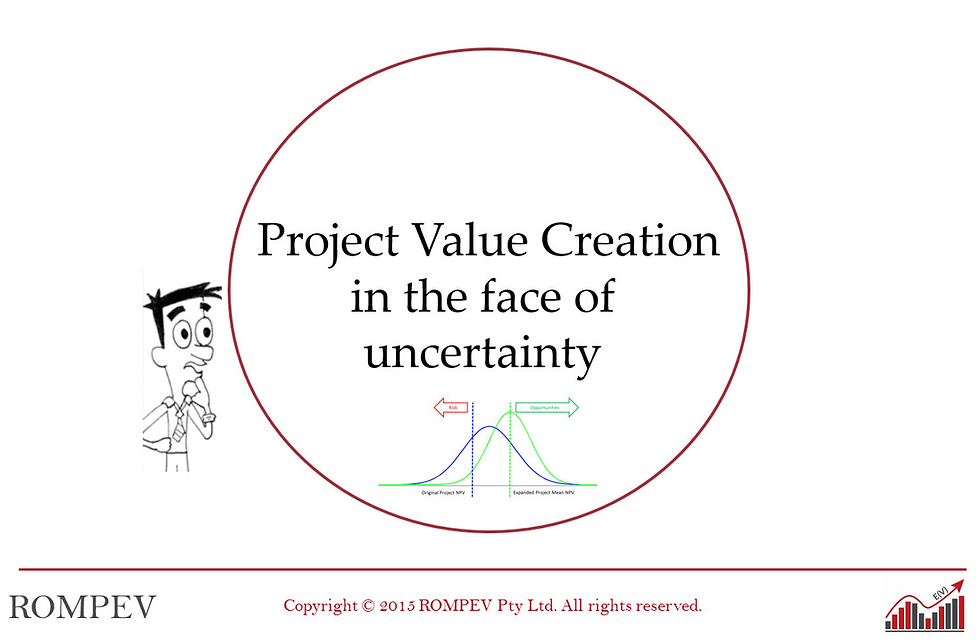
Should we improve the way we evaluate mining projects or continue doing it as we did already 20 years ago?
By Dr. Luis A. Martínez Tipe, PhD Director General & Principal Researcher, CAIDTech Originally published: November 6, 2015

I recently attended a one day class about the importance of feasibility studies when evaluating a mining project. I attended it, because I wanted to know the opinions and comments of the different speakers (experts on the different stages of a Feasibility Study) about how the current market downturn was affecting the mining industry, and what new advances in evaluation processes where on their way in order to deal with this problem in the future. The following questions were in my mind while walking (early in the morning) to the theatre (well, actually my first thought was to get a coffee):
1. Is traditional project evaluation processes, based on expected values, still the best way of evaluating a mining project – which normally have a life of mine in the order of tens of years?
2. Is it possible to deal with future market uncertainty when preparing a feasibility study of a mining project- or do we just need to accept that it is impossible to do it and have to resign to hoping for the best?
3. Have we realised that we may be doing something wrong by providing one number as answer, instead of a range of values – with probabilities?
4. Wouldn't it be our responsibility, as experts, to provide our clients a complete information about the future performance of their mining projects – which includes uncertainty?
5. Would our clients – mining industry – like to have a range of values with probabilities as an answer instead of just one number, which may be true, but for sure most of the time will be false?
6. Should I just not care about this because our clients traditionally do not care about uncertainty?

In general it was a very nice and educative course in which all the presenters provided the traditional steps used in preparing a feasibility study, focused on their expertise, but none of them actually talked much about the inherent uncertainty in the different processes involving a feasibility study. It seemed as if we were not in a market downturn and everything was going very well, as predicted a couple of years ago, which was not true. I then asked the question of why there was not an expert in the course talking about the effect (and ways of managing) of uncertainty, i.e., risk and potential, within a feasibility study – isn't a prediction of the future performance of the mining project, which for sure will be full of uncertain events? The reaction was interesting and the answers as well. For example, someone told me that basically we experts in feasibility studies do not focus (learn?) about risk and uncertainty because our clients are not interested on it or because they simply do not request this type of analysis. But, is it not our responsibility, as experts, to tell our clients about the risks and opportunities that their project could face in the future? I believe this would be the type of transparency our clients would expect from us, the experts. Another interesting observation someone told me was, why to bother about analysing the risk of the future of a project if the managers, or we, may not be working for that project (?) in 5 or 6 years. This was something that goes against what the industry tries to promote about sustainability, isn’t a sustainable mining project the one that cares for current resources without destroying the opportunities for future generations? Anyhow, it was also nice to hear from the public some comments about that may be we (I include myself) are doing something wrong and should be looking for other alternatives to complement current ones – which is true and correct because current techniques work well, but they cannot deal with uncertainty. After the panel debate, I wondered if I was seen as the guy who always ask silly questions about uncertainty, i.e., risk and opportunity, but it didn't, and does not, worry me because a debate panel is for asking questions, and because I believe that even though it is a topic that no one (apparently) wants to discuss, we need to start doing it now because the future will always bring uncertainty, and we need to start asking the right questions and seek the solutions, to avoid big loses (because no one can predict the future with 100% certainty) while learning along the way. I was thinking to may be apologise to the panel or the public for touching this “taboo topic (?)”, but I will not do it because I really believe that new things always appear and happens when questions (good or silly ones) are asked. Hopefully very soon we will start hearing about solutions to the problem of dealing with uncertainty in mining projects instead of getting scared or offended when hearing the word. As a matter of fact, there are new techniques that can help and assist in this task, but as one panellist highlighted, they are still new and not well understood – which I agreed with and which means we need to start putting hands on it now and not tomorrow when another downturn hits the industry. Editor's note: This article was written in 2015. Since then, CAIDTech has developed and applied the probabilistic frameworks described here across multiple mine projects in Latin America and Australia, integrating geological variability, operational dynamics and economic uncertainty into a single quantitative model. Learn more at [caidtechnology.com]