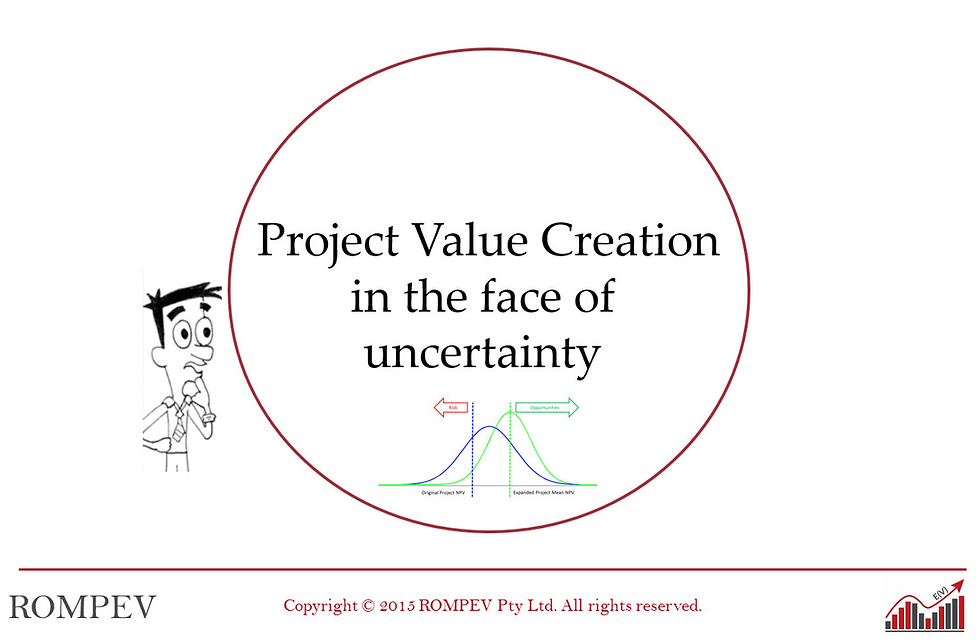
So, can we predict the future, or it is arbitrary and random?
If so, why do project decision makers keep forecasting the future with average values?
By Dr. Luis A. Martínez Tipe, PhD Director General & Principal Researcher, CAIDTech Originally published: January 21, 2017

INTRODUCTION
Ever since Laplace's time (Laplace's demon, 1814), the idea of being able to know what will or might happen in the future has been a central tenet of science, and consequently a tenet of any process, system or activity where future values need to be used.

In practice, however, when evaluating projects our capacity to foresee what's to come in the future is extremely restricted by the complexity of the diverse nature of the conditions, and the fact that they often have a part which is very difficult to model properly, called randomness (due to the lack of data about future events), turning the evaluation process into a stochastic process over time.

Since a stochastic process is a process governed by probabilistic laws, and which does not depend on initial conditions, all we can do is calculate probabilities. No one can make any definite predictions with 100% certainty; that is, if the process yields a specific outcome, then, there will be different outcomes that might follow and the probability distribution will be the means of measuring their likelihood of occurrence.
NATURAL RESOURCE PROJECTS
In the specific case of natural resource projects, e.g., a mine or an oil project, the analysts and managers need to forecast, in some way, the values of different technical and economic variables for the life of the project which are in the order of tens of years. Examples of these are variables costs, grades, qualities, product production, and prices, among others. Normally these forecasted values are represented by averages or expected values (and sometimes best guess values).
Current (traditional) techniques for project evaluation, such as the net present value (NPV) and internal rate of return (IRR), are based on the discounted cash flow (DCF) model, which uses averages or expected values to calculate the project value and project cash flow (CF), at each production period, and uses a discount rate factor, r, (normally assumed to remain constant over time) to account for project risk in the future.

THE BIG QUESTION
So, if it is clear that the evaluation process of a natural resource project (and in general any project that uses forecasted values) follows a stochastic process over time, then, why it is frequently seen that uncertainty is denied by decision makers, and replaced by either best guesses or expected values?
It is as if analysts and managers were playing dice with future project values; it is kind of assuming that all forecasted (expected) values for the different variables used in the project evaluation process will occur together at each epoch with 100% certainty, which is not correct. As a matter of fact the probability of this happening is much less than 100% because of uncertainty.

SOME ANSWERS
Among all possible reasons why uncertainty is normally neglected in the project evaluation process, both the lack of knowledge about statistical sciences and the understanding of the mathematics behind the theory of applied probabilities needed to measure the probabilistic laws, are the ones that are more frequently observed.

Other reasons why uncertainty is normally neglected in the evaluation process of a natural resource project are the additional resources needed to do further analysis based on advanced processes that includes uncertainty; i.e., after doing the traditional NPV-DCF analysis, which in most of the cases is not a trivial process,. Additional human effort, computing and time demands are normally necessary to understand, assess, and manage uncertainty. These extra resources are normally visualised as additional “unnecessary” expenses since no worldwide standard code for project evaluation, such as the VALMIN and the NI 43-101, indicates such a processes as mandatory for project evaluation, which I personally believe is limited (some of them just suggests to do some basic risk analysis).

Furthermore, unless they have direct coaching, managers and decision makers most of the time find interpreting results difficult and opaque because normally the concepts and stages behind advanced processes that includes stochastic processes, such as quantitative a risk analysis, real options, and scenario planning, are normally presented in an extremely complex fashion when they are implemented and reported. It is common for decision makers to visualize the concept of stochastic processes and probability theory as “black-box” processes.

A SHORT CUT TO RISK ANALYSIS (?)
To overcome the problem of running advanced processes to assess and manage uncertainty, e.g., a quantitative risk analysis and a real options analysis, it is normal for managers and decision makers to conduct numerous deterministic “what-if” analyses and then trying to assimilate all of the results into a coherent picture. This practice, however, does not provide a clear outcome but only a warning of possible scenarios to happen; i.e., which scenario to choose and why.

SOME COMMENTS
Since natural resource projects require high capital investments, in the order of hundreds of millions, there is no doubt that analysts, and project decision makers, face unprecedented challenges arising not only from changes over time in the different variables needed to evaluate a project. These changes also interact in complex ways, introducing an array of compounded uncertainties that confound them, let alone investors.

While uncertainty is not new to natural resource projects, limitations in our ability to confidently predict the future using traditional techniques based on expected values reinforce the need for:
Development of advanced project evaluation processes and tools to cope with the associated uncertainties; and
Encouraging decision makers and analysts to cultivate the knowledge about applied statistics and mathematic sciences to be able to understand and apply stochastic analysis when evaluating a natural resource project – after all probability theory is not too scary at all.

BEST PRACTICES IN NATURAL RESOURCE PROJECT EVALUATION
When evaluating a natural resource project it is recommended to always perform the following steps:
Apply traditional techniques to plan, design and value the project;
Identify main sources of uncertainty via sensitivity or tornado analysis;
Prioritise and rank main sources of uncertainty;
Quantify selected uncertainties at their source and over time, i.e., generating a distribution of probabilities for each uncertainty, including their correlation, at each epoch;
Run a dynamic quantitative risk analysis to assess the effect of the uncertainties in key project key indicators;
Interpret and report results in easy to read charts and diagrams.
GOING BEYOND QUANTITATIVE RISK ANALYSIS
One of the big questions after running a quantitative risk analysis is, “what else to do?”. That is, being aware of the future project risks and opportunities is valuable information but not necessarily useful if this information is not expressed as value added. Sometimes, experience provides valuable insight to identify strategies that could minimise/maximise some risks/opportunities. However, because of the complexity of the evaluation process, experience will not always provide reliable practical solutions or strategies without the aid of specialised optimisation techniques.

The use of advanced decision making-optimisation processes, such as real options analysis and scenario planning, are very useful to identify best strategies to manage project uncertainty over time, i.e., to reduce project risk and maximise project opportunity over time, while improving current project value. This will provide project decision makers insights into future trajectories that may unfold, and prepare managers to respond appropriately in the near and long term.
We cannot forecast the future, but we can take a proactive position and prepare for good and bad events in the future... we just need to see beyond traditional processes. Editor's note: This article was written in 2017. Since then, CAIDTech has developed and applied the probabilistic frameworks described here across multiple mine projects in Latin America and Australia, integrating geological variability, operational dynamics and economic uncertainty into a single quantitative model. Learn more at [caidtechnology.com]