Why Accounting for “Uncertainty” Improves Final Decision-Making in Strategic Mine Project Evaluation
By Dr. Luis A. Martínez Tipe, PhD Director General & Principal Researcher, CAIDTech Originally published: September 27, 2016

CURRENT FRAMEWORK
The current economic downturn has shown that managerial strategy and operational transformation is a top priority for engineers working in a mine operation as well as for the management team. Mining organisations that do not cope with chance and uncertainty within the evaluation process relies more heavily on instinct to make critical final decisions that tends to be more subjective, spurious, lack rigor and produce poorer outcomes.
Hence, a new era is coming for the mining industry. An era where mine planners, mining engineers and mine analysts, not only ask themselves the question, ‘What if ...?’ when evaluating their respective mine, but also want to know what is the effect of these ‘What if..?’ uncertainties on their project evaluation process, as well as the best strategies to follow when facing either an adverse or a favourable condition.
Using intuition, it is logical to be asking these ‘What if ...?’ questions when evaluating a mine project. The reason for this is that normally a mine project has a long-term operating life and those of us that are involved in mine project evaluation are aware that the future brings uncertainty. It is within this environment that mine planers/analysts have to manage the level of uncertainty of their projects, so they can make decisions based on rational and disciplined thought.
Even though it is getting more common to see project managers making final decisions based on an expected mine value and a sort of interval of confidence, where the risk/potential for future losses/opportunities are assumed to be covered, there is still some reliance from most of them in working with a given expected mine value number.
One of the common arguments I have observed for using just one (estimated) number for making final decisions is that it is a simple process. Conversely, decisions based on a distribution of probabilities are not straightforward and further analysis, such as conditional simulation, scenario analysis and risk analysis, need to be made.
Another common argument the author has listened to is that it is not worth the trouble of making decisions based on risk analysis when the final results will not differ much from the single ‘expected’ value. Indeed, a mine evaluation process based on risk analysis is more costly and time demanding than an evaluation process based on single estimates.
The previous arguments clearly indicate that the main problems for which uncertainty and risk are normally neglected from the mine evaluation process are due to:
Lack of knowledge about the differences between making decisions based on expectations resulting from either a single or a distribution of values, especially when working with complex processes such as the mine evaluation process; and
Lack of appropriate mine evaluation framework and tools that are able to include the ‘What if ...?’ uncertainties into the mine evaluation process appropriately and within a reasonable timeframe.
Consequently, the mining imperative calls for new alternatives and tools to analyse and evaluate a mine operation in the face of uncertainty.
Mining companies can’t just dabble at the edges by keep using traditional processes and techniques which do not consider uncertainty.
MAIN SOURCES OF UNCERTAINTY IN MINE PROJECT EVALUATION
Mine projects are complex businesses that demand a constant assessment of risk. This is because the value of a mine project is typically influenced by many underlying economic and physical uncertainties. Some of the main sources of uncertainty are:
Uncertainty in orebody modelling: The geology of the ore deposit represents one of the most critical sources of technical uncertainty in a mine operation. Uncertainty in orebody modelling arises because the information obtained from the drill-hole samples is not representative of the entire (3D) ore deposit. One consequence of this lack of information is the misclassification of resources, where economic ore can be dispatched to the waste dump and non-economic ore can be sent to mill.
To minimise the misclassification of resources, estimation techniques based on stochastic models, e.g., Kriging and Conditional Simulation techniques, are commonly used to estimate the geological information at non-sampled locations.
Uncertainty in metal prices: Another important source of uncertainty which has a critical impact on mine project evaluation is that associated with future metal prices. Uncertainty of future metal prices arises because of two main factors:
the lack of exact knowledge of those factors leading to the increase/decrease in metal supply and demand, and
the practices that producers or consumers perform in the face of powerful speculative and political motives.
Advanced models based on stochastic processes, such as Geometric Brownian and Mean Reversion models, are normally used to quantify future price uncertainty enabling mine planners and managers to assess its effect on project economics.
Uncertainty in production costs: Production costs are another source of uncertainty when evaluating mine projects. The reason for this is that the economic evaluation component of the feasibility study is based on information that provides an answer to the question, ‘what is it going to cost?’ Since estimation of capital and operating costs is an important requirement for open pit mine evaluation, uncertainty in costs arises due to the lack of engineering or economic information at the beginning of the mine project. Simply put, mining companies do not know with absolute certainty today how much they will be able to spend tomorrow, let alone next month or even next year.
Uncertainty and risk in open pit mine planning and design: Since both the ultimate pit and the production scheduling limits depend directly on the orebody model and future metal price and costs, uncertainty and risk in open pit mine planning and design arise due to the uncertain nature of the underlying variables that take part in the designing and planning process. In this context, the allocation of the physical limits of both the ultimate pit and long-term production sequence on the orebody model turns into a complex and uncertain process.
THE ‘FLAW OF AVERAGES’ IN MINE PROJECT EVALUATION
Traditionally, mine organisations use various types of quantitative methods to estimate profit and loss associated with a proposed mine project. Among all these measures of profitability, the net present value (NPV) which is based on the discounted cash flow (DCF) technique is the most widely used in the mining industry. In practice, the expected cash flows generated at each production period are estimated using expected values for the underlying variables.
One consequence of using expected values when estimating cash flows is that the resulting NPV value is also assumed to be an expected value, which may not be reflecting the real project’s value leading to incorrect decisions. The problem with evaluation techniques based on the DCF is that in cases involving uncertainty and non-linear processes, in our case the mine optimisation and evaluation process, single estimate values are often of little use because of their lack of accuracy in describing an uncertain process. We refer to this problem to as ‘The Flaw of Averages in Mine Project Evaluation’.
REAL OPTIONS ANALYSIS TO THE RESCUE
Real options analysis (ROA) is a valuation and strategic decision making tool that applies financial option theory to real assets. Real options differ from financial options in that they deal with risky tangible assets, such as mining and petroleum projects, rather than financial products. But the concepts underlying their usefulness as a tool for dealing with uncertainty are the same.
In the mining context, the similarity and differences between financial (American) call option and a (real options) mining project are presented in Table 1.

In terms of the overall process to complete a real option analysis on a mine project, it is important to note that the method is based on a traditional DCF which provides the base case NPV as the primary input into a real options analysis. The next step is to identify the key sources of uncertainty and establish the relative impact of these on project value. In order to do this it is necessary to determine appropriate parameters for these uncertain variables. One good way to do this is to analyse the variance of historical values and use this to predict how that variable changes over time. However, not all variables may be available and as such one may have to estimate the future value of a variable and apply confidence limits in order to calculate the expected variance.
These uncertainties are then combined to estimate the expected volatility in the project value. Management should then identify opportunities and strategies to respond to these key uncertainties (e.g. can they realistically expand, contract, abandon, etc.) and determine the impact of such measures.
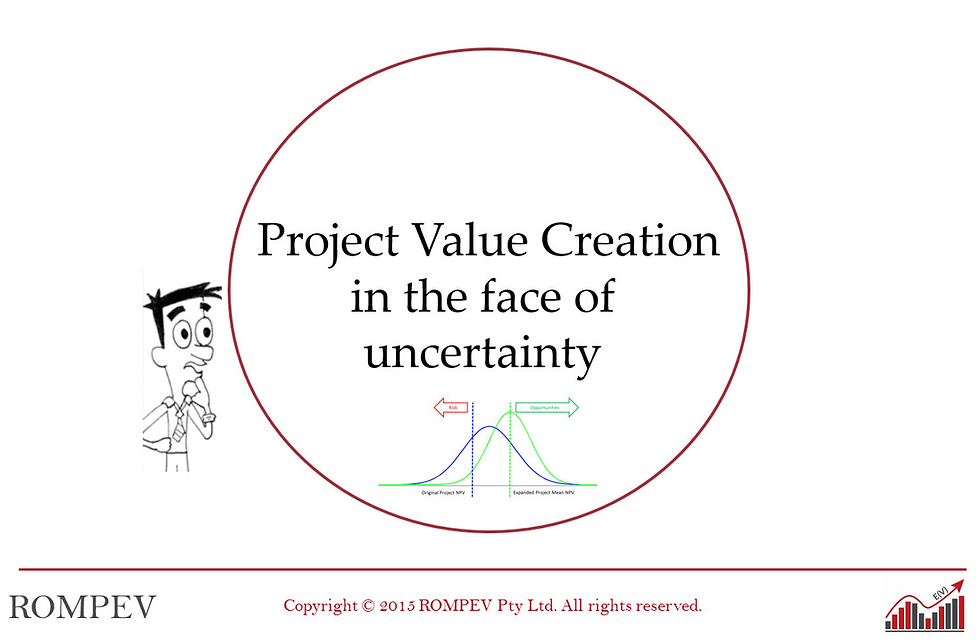
These uncertainties and opportunities are then combined in a valuation framework which is then solved to determine the expected value of the real option. The real option value is then added to the base case model to give the Expanded Net Present Value (ENPV) (Figure 1) of the project. In short, the process behind real options analysis can be summarised as indicated in Figure 1.

COMMENTS AND CONCLUSIONS
Although not well understood yet in mining, it is important to observe that an accurate real options analysis will provide a more holistic analysis of a project performance than traditional DCF analysis adding additional value to a mine project.
This is because ROA has its fundamentals in quantified uncertainty and risk analysis, which not only give mine planners/analysts a realistic range of the final outcomes over time, but also give them the flexibility to implement the best operational and managerial strategies that will react to either an adverse or a favourable condition to take advantage of the opportunities, while mitigating the risk for losses.
Furthermore, conversely with traditional DCF analysis, one advantage of using ROA when evaluating mine projects is that it allows mine owners and managers to optimise their mining projects by planning and designing the best operational and managerial strategies that will maximise current value while taking care of the future, that is from a sustainable mining perspective, but this needs further investigation and is a topic for another paper.
Note that to be able to implement complex ROA in mine project evaluation new advanced tools need to be developed as current traditional processes and tools only deal with single values and do not consider uncertainty appropriately. Editor's note: This article was written in 2016. Since then, CAIDTech has developed and applied the probabilistic frameworks described here across multiple mine projects in Latin America and Australia, integrating geological variability, operational dynamics and economic uncertainty into a single quantitative model. Learn more at [caidtechnology.com]