Paraguay got the geology right. Everything else is still being written
Actualizado: 13 jun
CAIDTech Research Series | Asuncion, Paraguay | May 2026
A conversation with Victor Fernandez on thirty years of patience, a billion-dollar investment decision, and the methodological gap the mining industry has not closed.

Interview conducted and edited by Jean P. Muñoz
Paraguay will soon host what may become one of the largest and highest-grade titanium deposits ever brought into production. The decision to build it, worth somewhere between half a billion and one billion dollars, is being made in a country that did not have a functional mining law until the year 2000, has no historical production baseline for its mineral deposits, and is still in the early stages of building the geoscience institutions that would normally underpin a project of this scale. The geology is there. The methodology is still catching up.
Victor Fernandez has been working in that gap for thirty years. Trained at Germany's Federal Geological Survey, with specializations in remote sensing and economic geology, he is today Country Manager of Uranium Energy Corp in Paraguay and chairs the country's national mining chamber, CAPAMI. He was prospecting Paraguay's mineral potential before most of the industry knew the country had one.
This interview, part of the CAIDTech Research Series, is not primarily about the project. It is about a problem that sits upstream of the project: how large-scale investment decisions get made in territories where the data infrastructure that normally supports those decisions does not yet exist. What Mr. Fernandez describes, and what he leaves open, maps directly onto the research question CAIDTech has been pursuing for years. 1. WAITING AS STRATEGY
While most accounts of Paraguay's emerging mining sector begin with the new law of 2000, Mr. Fernandez's account began three decades earlier, with a set of geological surveys most of the industry had filed away and forgotten.
When did you know Paraguay had something the industry was underestimating?
From the moment I encountered the existing geological information. The presence of uranium, gold, and rare earths documented by the Anschutz Corporation in the 1970s. It was during my early years as a student, and that knowledge made me think there was real potential here, something that needed to be uncovered. I never doubted that Paraguay could have something important. I had the patience to wait for the right moment, which came in the 2000s. Many colleagues of my generation shared that dream. But the slowness of the process led several of them to move into other fields. I was stubborn and decided to stay in mining until the moment arrived.
RESEARCH NOTE · CAIDTECH The decision to stay is, in formal terms, the exercise of an option. In real options analysis, deferral is not passivity. It is the act of preserving the right to invest under better conditions, regulatory, technological, or market-driven, while avoiding the cost of premature commitment. The projects that failed in the 1990s were not wrong about the geology. They were wrong about the timing. Those are different problems, and they require different tools. Fernandez held the option. The industry did not have a framework for pricing it. |
Peru is often cited as the regional benchmark. What does Paraguay actually need to learn from it, and what should it avoid?
The first success is understanding mining the way Peruvians understand it. The way their laws are written, the way they have structured the legal framework for the sector: that says a great deal about Peru and it is on the right track. The results speak for themselves. 2. STARTING FROM ZERO, AT THE BEST POSSIBLE MOMENT
Paraguay's sedimentary cover is not an obstacle. It is, in Mr. Fernandez's reading, a scientific problem worth solving. The Alto Parana Titanium Project does not sit in exposed terrain where the geology announces itself. It sits beneath thick layers that have to be worked through, interpreted, and ultimately understood on their own terms. That is where the science lives.
UEC operates under SEC SK-1300 standards. That is a demanding disclosure and reporting framework. How prepared is Paraguay's engineering and institutional base to sustain that level of rigor over the life of a project?
Uranium Energy Corp is in Paraguay precisely because the geological conditions here are ideal for developing environmentally sound methodologies. In the case of titanium, the mine will not require chemical reagents. Only water and magnets. We went to Puno to review projects, and what it confirmed was exactly that: we have ideal conditions for a clean, in-situ extraction process. In Peru the geology is exposed, you can see it from the surface. In Paraguay, on the other hand, thick sedimentary covers hide the geology and make the work more difficult. But those challenges appeal to me as a geoscientist. They force me to find new ways to reach the information.
RESEARCH NOTE · CAIDTECH There is an urgent need to pioneer research in advanced geoscience techniques to improve the accuracy of mineral resource estimation beneath these heavy cover. By integrating geostatistics with modern data science and AI techniques, CAIDTech geoscientists can build predictive models, decode hidden subsurface patterns, and significantly reduce exploration risks where visual data is unavailable. |
3. THE DECISION NO MODEL HAS FULLY SOLVED
The Alto Parana Titanium Project will require a Final Investment Decision in a territory with no comparable historical production, during a period of structural volatility in critical mineral prices, and under a regulatory environment that is still maturing. The question of how that decision gets made is not only a business question. It is a methodological one.
At what point does team experience stop being sufficient as the primary basis for a decision at this scale, and what would a more rigorous framework actually need to account for?
Uranium Energy Corp has tremendous technical and commercial capacity at the global level, and that provides a strong foundation. Decisions are made as a team, with people who have worked in mines in Africa, Canada, and the United States. In an environment of that level of technical depth, one might almost say that certain decisions become straightforward. Ongoing accompaniment throughout the process is fundamental. There is no hesitation when it comes to bringing in consultants or experienced specialists. That is what makes Uranium Energy Corp such a productive place to work.
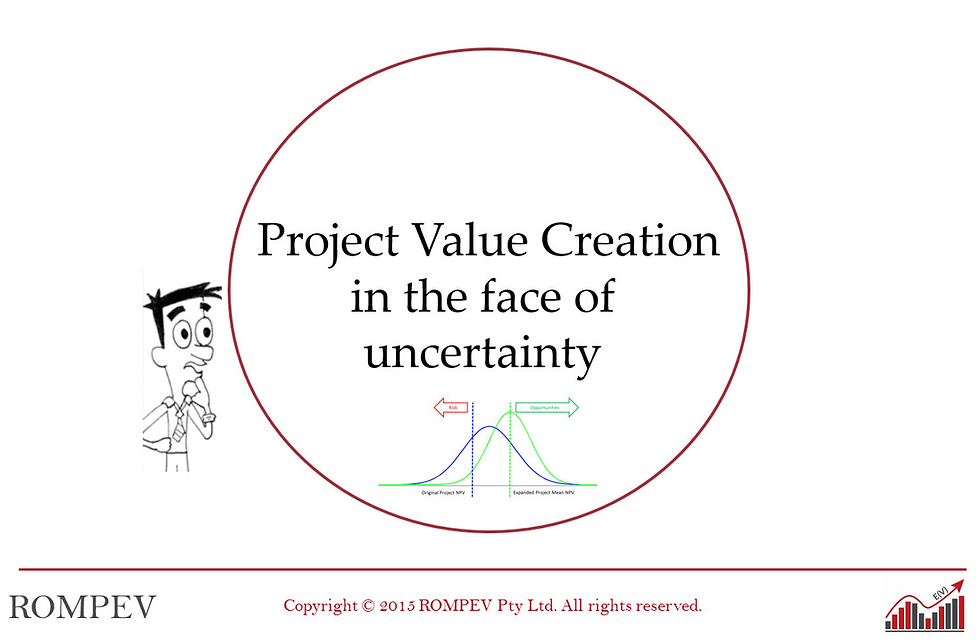
RESEARCH NOTE · CAIDTECH That instinct is correct as far as it goes. Experienced teams calibrate intuitively to what quantitative models try to formalize: the shape of the uncertainty, the scenarios that matter most, the variables that are truly independent. But at this scale, with simultaneous uncertainty in titanium prices, the regulatory framework, logistics, and exchange rates, it holds formally that F(E{x}) ≠ E{F(x)}. The average of the scenarios is not the average scenario. Team competence informs the probability distributions. It does not replace them. The gap between those two statements is where investment decisions of this magnitude are lost or won. It is also where CAIDTech's research is focused. |
4. A BOOK WITHOUT WORDS
Mr. Fernandez is direct about what Paraguay lacks. That directness is itself significant: the country's openness about its institutional gaps is part of what makes it tractable as a research environment.
What is the honest assessment of where Paraguay's geoscience and research infrastructure stands, and what would it need to support the kind of institutional knowledge base that serious mining development requires?
Paraguay is like a book without words. There is still so much to write about its petrology, its geological paragenesis. It is the ideal setting for university research. Paraguay does not have a consolidated geological school. It is young. That makes it an open space, ideal for the convergence of academic work and cooperation between faculties in Peru and Paraguay. In just twenty years under the new mining law, three significant projects are already underway, one of which will become the largest titanium mine in the world. That speaks to the potential. But it is potential in a territory that remains, in large part, unexplored.
RESEARCH NOTE · CAIDTECH "A book without words" is also a precise description of the calibration problem. Quantitative risk models depend on historical data to set prior distributions. In a territory with no production baseline, those priors have to be constructed from first principles, from regional analogues, from geological inference, and from expert judgment that has not yet been formally encoded. In that environment, epistemic uncertainty, what we do not know we do not know, structurally dominates aleatory uncertainty, the randomness we can model. That distinction is not academic. It determines how a QRA is designed, how conservative the confidence intervals need to be, and how residual risk gets communicated to institutional investors operating under SK-1300. Paraguay is not a harder version of a standard mining jurisdiction. It is a different kind of problem. The tools need to reflect that. |
What would you say to the Victor of thirty years ago, standing at the beginning of all of this?
You have to be like a soft drop of water falling on hard stone. Drop by drop, it shapes it. You have to persist, have patience, be resilient, and stay focused on the goal. When you know what you want, you reach it. Here we are, like the drop.
ANALYTICAL CONCLUSION · CAIDTECH
Mr. Fernandez spent thirty years holding an option the industry did not know how to price. The geology was right. The timing was not. When the conditions finally aligned, the project that emerged is now among the most consequential mineral developments in South America. What this conversation makes clear is that the methodological infrastructure has not kept pace with the geological opportunity. The team behind the Alto Parana Titanium Project is experienced, globally credentialed, and rigorous in ways that matter. But experience, however deep, does not resolve the formal problem of making a billion-dollar investment decision in a territory without a historical production baseline, under simultaneous uncertainty in prices, regulation, and logistics. That is not a criticism of how the decision is being made. It is a description of the frontier that the industry, and research centers like CAIDTech, still need to close. |
CAIDTech ·Centro Avanzado de Investigación & Desarrollo de Tecnología Minera