The (Missing) Economic-Valuation Aspect of Innovation in Mining
By Dr. Luis A. Martínez Tipe, PhD Director General & Principal Researcher, CAIDTech Originally published: August 22, 2018

It seems that current economic downturn (which seems to be in its last stages) has triggered the need for technological innovation in the mining industry. This is the reason for which, currently, there is much talk in the mining business about the requirement for research, development, and innovation, to start game-changers corporate innovation projects. Nonetheless, despite the most impressive innovations being researched and implemented at some mining companies over the past couple of years (normally major companies), there seems, by all accounts, to be small going with talk about how to assess the value created by these projects before settling on a thumbs up investment decision choice - it is as if innovation projects automatically create value and therefore do not require a supporting economic analysis and, accordingly, don't require a supporting monetary investigation.
The lack of discussion about estimating both the cost and the value of implementing innovation in mining is odd as the tools to perform this type of analysis have been developed as part of decision theory and real options analysis which are used on other industries such as petroleum industry where it is used, for example, to estimate the value of exploration programs - I call this phenomena the curse of disruptive technologies in mining. As a matter of fact, in my years of working in the mining industry (in both open pit and underground mining) there were many occasions of witnessing innovations (including some of the current ones) seeking better ways of mining, processing and designing infrastructure, mostly to save costs, using a kind of black-box approach to decision-making. Despite these innovations could pass the early gates in the process, the closer to Feasibility Investment Decision (FID), the less likely these would be acceptable, mainly because:
High upfront capital expenditure required to implement these innovations;
Lack of trust in final results (who else is doing it and what were the results?);
Need of mining sector to adopt a distinct culture shift changing its operations in response to innovation (technological disruption);
Need for upskilling the future workforce and engineers (starting at the universities, which are not yet prepared to include the foundations of these innovations as part of their study curriculum).
These are reasons (among many others) for which disruptive innovation technologies are, in most of the cases, still not well appreciated in the mining industry.
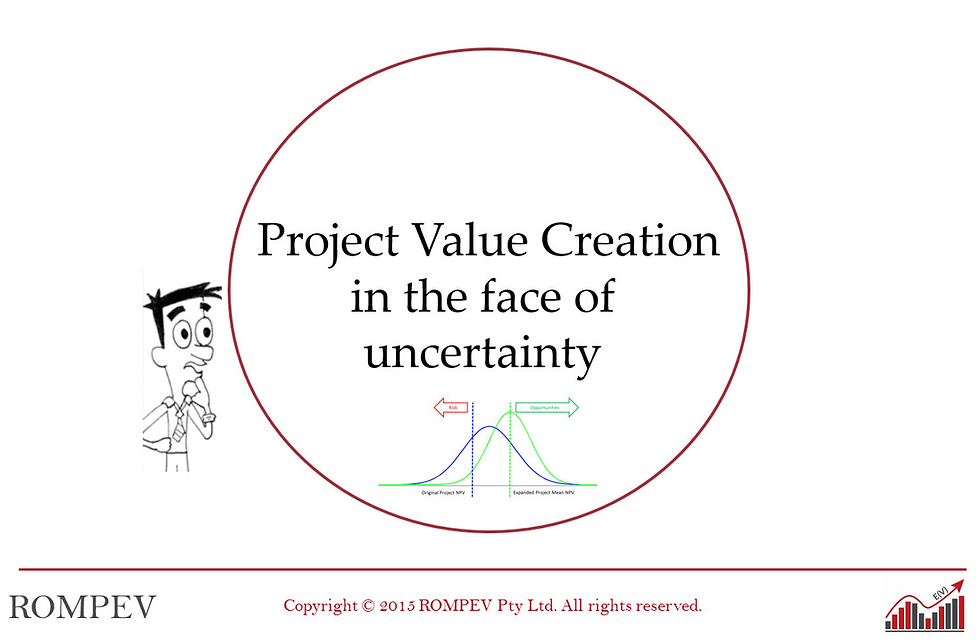
Traditional analysis and valuation techniques based on simple statistics analysis and the NPV-DCF are not able to quantify appropriately the benefits of these innovation technologies suggesting, in most of the cases, the non-implementation of them; one example of this are caving mining operations, which have high initial capital expenditure (CAPEX) due to the initial undercut and extraction infrastructure required prior to starting the main production phase.

Please do not get me wrong, I am supportive of innovation and the development of new technology to be applied in mining (and other industries), but I am also trying to be realistic facing the need for developing new ways to evaluate these so called “disruptive technologies” to be able to show, today, their value added throughout the mine value chain.
This is the reason why we at R&O Analytics are exploring and investigating the application of advanced data analytics, machine learning, AI techniques, with advanced mine evaluation techniques based on real options-scenario analyses, to be able to quantify the benefits of developing and implementing these new innovations in mining.
We are aware this is a complex topic reason for which we welcome collaboration with other companies, research centres, or researchers interested in the same topic, and we also learn from other experts in the topic (for example my good friend Michael Samis will talk about this topic at the “Extraction 2018 conference on August 26”, unfortunately I will not be able to attend it). Editor's note: This article was written in 2018. Since then, CAIDTech has developed and applied the probabilistic frameworks described here across multiple mine projects in Latin America and Australia, integrating geological variability, operational dynamics and economic uncertainty into a single quantitative model. Learn more at [caidtechnology.com]